
A Pool of Models Narrows the Overlap — It Doesn't Erase It
updated
Confidence cited research plus cross-family experience; the boundary itself is a wager
“All models are wrong, but some are useful.” — George Box
Sakana AI shipped Fugu with a clean pitch: one endpoint that routes your task across a pool of models — calling itself recursively — and handles selection, delegation, verification, and synthesis internally. On code review it “finds the bugs others miss.” It runs research “with little to no human intervention.” The premise underneath is seductive: enough models checking each other converge on the truth.
They converge on something. It’s just not the truth, and it’s not your intent. A pool of models narrows the overlap between their blind spots. It doesn’t erase it — and the part it can’t reach is the part that was always yours.
Bottom line up front
- A panel of personas on one model is theatre. Five “experts” on one model is one model in five hats, nodding at itself. Its agreement isn’t independent evidence; use it for coverage — the considerations you’d have missed — never as a vote.
- Real independence comes from a different family, not more personas. A different family is blind in different places, so it catches what yours sailed past. That’s what a pool of different models actually buys.
- A different family still isn’t independent. Models err alike, and the overlap grows as they get better. A pool shrinks the shared blind spot; it never clears it.
- None of it checks intent. Every model verifies what you specified. What you meant — the part you never wrote down — is, by construction, invisible to all of them at once: none was ever given it.
- Coverage isn’t a decision. A pool floods you with considerations and candidates; it can’t make the call. Enlist it to argue — a panel for coverage, a different-family judge to weigh — but the verdict stays yours.
- So use the pool for what it’s good at: the findable, the exploratory, the low-stakes. Keep the reading, and the verdict, for anything that has to be right.
Personas are coverage, not a vote
Start with the cheap version of the promise, the one that runs inside a single model: five expert personas checking each other. They agree, and the agreement is theatre. Persona conditioning changes the framing, rarely the call; on subjective-labelling tasks the persona accounts for under a tenth of the variance (Hu & Collier, 2024). The agreement isn’t independent evidence — otherwise you’re watching one model laugh at its own joke in five voices. A named persona breaks from the pack only where its corpus genuinely dissents (Argyle et al. 2023, on demographic personas; the expert-corpus read is mine).
That’s not nothing. A panel surfaces considerations you’d have walked past — coverage. It just can’t hand you a decision, because the disagreement a real vote needs isn’t there. The method for running one, and why its agreement counts for nothing, is The Brief’s; I won’t re-derive it.
A different family is the real check — up to a point
Step up to the version that matters: not five hats on one model, but a genuinely different family. Here the diversity is real. Pointed at the same work, a different family catches what the producing one is blind to — the over-claim, the dropped contract, the bug your own read nodded straight past. That’s not theory. It’s the everyday experience of handing your work to a different model and watching it bleed red where you were sure you were clean. A pool of different-family models is that, systematized. When Fugu “finds the bugs others miss,” this is the likely mechanism, and the effect is real.
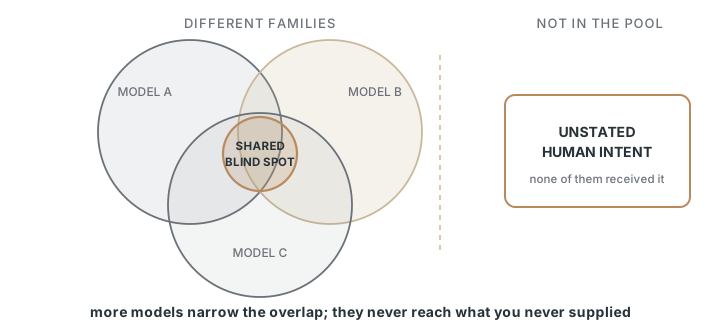
Then you hit the floor. Different families train on overlapping data towards similar objectives, so their errors don’t scatter — they correlate. Kim et al. (2025) measured that correlation; it rises with capability, across providers and architectures. So the better the models get, the more alike they’re wrong. Add that “I don’t know” is rarely what training rewards (Kalai et al., 2025): neither model abstains, each hands you a confident completion, and given the correlation, often the same wrong one. Pool a thousand and the shared blind spot shrinks. It doesn’t vanish. That’s the whole game in a line: narrows the overlap, doesn’t erase it.
And it isn’t only errors that correlate. Transluce (2026) varied the identity a model could infer it was talking to — an account email, a folder name, a memory file — and measured the behavioural shift across 24 models from six families. Twenty-two moved the same direction, and not one moved significantly the other way. That’s a bias nobody was pooling against, running the same way across the whole field: pool those models and you average it in. The effect size didn’t track release date, so this one isn’t obviously riding Kim’s rising curve — the agreement across families is the part that lands here.
The part no pool can reach
There’s a second limit, and it’s worse than the floor. Every model in the pool — however many families, however adversarial the cross-check — verifies what you specified. Intent, the thing you meant and never wrote down, isn’t in the artifact for any of them to read. You can’t catch a blind spot with a tool that shares it, and unstated intent is the blind spot they all share by construction: none of them was ever told. Why that read stays human is A Description Can’t Replace the Code; adding models doesn’t weaken the argument. It sharpens it, because now the failure is correlated and silent.
Coverage isn’t a decision
Look at what the pool actually produces: considerations and candidates. Coverage. A decision is a different act, and no pile of coverage adds up to one. This is Fugu’s real sleight of hand — “synthesis internally,” “little to no human intervention” sells the decision, not the coverage.
You can compose the pieces well, and people do: a cheap panel to surface the considerations, then a judge to weigh them. That’s what Mixture-of-Agents (Wang et al., 2024) and debate-plus-judge (Du et al., 2023) already are — proposers feeding an aggregator; a heterogeneous panel of smaller judges can out-score a single larger one on the evaluated datasets, at lower cost (Verga et al., 2024 — supportive of the pool over one model, though it does not isolate family diversity as the cause). Make the aggregator a different family, because a model favours its own outputs — it grades its own homework (self-preference bias, Panickssery et al., 2024). Done that way it’s a strong pipeline. It still moves neither wall: the judge shares the correlated blind spot it’s ruling on, and nothing in the stack was ever told what you meant. And one fact kills the autonomy pitch outright — a model told to argue a side builds a rigorous, well-sourced-looking case for it (Irving et al., 2018), so no amount of cross-checking settles which side is right. You do, against constraints only you hold.
The candidates still need sorting, and the pool cries wolf. Point a different family at your claims and it flags real errors and confident nonsense in the same pass — a paper it swears refutes you that, read, confirms you. Necessary and unreliable in one breath. What sorts the real catches from the false alarms isn’t another model; it’s reading the source instead of trusting the verdict. Stack more models and you get more candidates, not fewer reads.
The seat you keep
So price the pitch precisely. A pool of models is real leverage on the findable — it surfaces more, caught faster, than any one model. That’s worth having, and “little to no human intervention” is the right setting for exploration and anything cheap to get wrong. Aim the same promise at production intent and it fails twice over: the errors correlate where confidence is highest, and not one model is checking what you meant. More models narrow the overlap; they never reach the reading. That last seat is the one you keep.
How sure I am: the correlated-error floor, the persona effect, and the composition prior art are cited research; the different-family-catches-what-your-own-read-missed and cry-wolf beats are experience from building across model families; and the boundary — more models narrow the overlap but never reach unstated intent — is a wager, argued from that research, not measured. The causal read on Kim (shared training and evaluation pressures) is mine, not the paper’s. The user-identity result was added after publication: the measurement is Transluce’s, the inference from it as a second axis the pool can’t average out is mine.
Sources
- Hu & Collier, “Quantifying the Persona Effect in LLM Simulations” (2024, arXiv:2402.10811) — persona variables account for under a tenth of annotation variance: conditioning shifts framing, rarely the call.
- Argyle et al., “Out of One, Many” (2023) — persona conditioning tracks real subgroup distributions, so a named persona breaks from the pack only where its corpus genuinely dissents.
- Kim, Garg, Peng & Garg, “Correlated Errors in Large Language Models” (2025, arXiv:2506.07962; ICML) — across 350+ models, errors correlate rather than scatter, and the correlation rises with capability across providers and architectures. The floor under the pool.
- Zhong, Raghunathan, Laidlaw & Steinhardt, “User Awareness in Frontier Models” (Transluce, 2026,
transluce.org/user-awareness) — models infer who they are talking to from in-context clues and shift confidence, grading and suspicion accordingly; 22 of 24 models across six families shifted the same direction on the strongest identity, with none shifting significantly the other way. Cited here as a correlated bias on an axis other than error, not as a second measurement of Kim’s correlation. - Kalai, Nachum, Vempala & Zhang, “Why Language Models Hallucinate” (2025, arXiv:2509.04664) — abstention (“I don’t know”) is rarely what training rewards, so each model hands you a confident completion instead of flagging the gap.
- Wang et al., “Mixture-of-Agents” (2024, arXiv:2406.04692; ICLR 2025) — proposers feeding an aggregator: the panel-then-judge pipeline this essay composes, named as prior art.
- Du et al., “Improving Factuality and Reasoning in Language Models through Multiagent Debate” (2023, arXiv:2305.14325) — debate-plus-judge as prior art for composing a pool.
- Verga et al., “Replacing Judges with Juries: Evaluating LLM Generations with a Panel of Diverse Models” (PoLL) (2024, arXiv:2404.18796) — a heterogeneous panel of smaller judges out-scored a selected large judge on the evaluated datasets, at lower cost and with less intra-model bias. Supportive of a pool beating one model; note it lacks a same-family-vs-different-family ablation, so it does not by itself prove diversity is the cause.
- Panickssery et al., “LLM Evaluators Recognize and Favor Their Own Generations” (2024, arXiv:2404.13076; NeurIPS 2024) — self-preference bias: a model grades its own output up, which is why the aggregating judge must be a different family.
- Irving et al., “AI safety via debate” (2018, arXiv:1805.00899) — a model told to argue a side builds a rigorous, well-sourced-looking case for it, so cross-checking can’t settle which side is right.
Related: The Brief (the cross-model method, and why same-model agreement is theatre), Give Away the Writing, Keep the Reading (intent is the human’s to keep), A Description Can’t Replace the Code (why the intent-check can’t be handed to any AI), A Flip Is a Missing Rule (the ceiling here holds, and is narrower than it looks — a pool can’t reach what you never specified, but a flip locates it).