
Confidently Wrong
updated
Confidence cited research plus experience; that calibration now beats confidence is a wager
“The first principle is that you must not fool yourself — and you are the easiest person to fool.” — Richard Feynman

A model handed me a clean answer once. Well structured, sure of itself, and wrong — and nothing in how it was written gave that away. It read the same when it was guessing as when it knew.
You’ve hit that one by now too. It’s why “the AI said so” quietly stopped being an answer and became a reason to go check. The error was never the problem — models get things wrong, so do people. The problem was that the output left me no handle to catch it. Fluent all the way down.
So the useful question isn’t how to make a model sound more sure of itself. It’s how any output — from a model, an agent, a tool — earns the right to be acted on.
Bottom line up front
- Useful first, or it shouldn’t exist. If nothing happens differently at the end of the report, don’t write the report. The rest is production value on something nobody needed.
- Trust is showing your work, not sounding sure. Hand over the raw under the claim and let me check it. A confident summary I can’t verify is worth less than a hedged one I can.
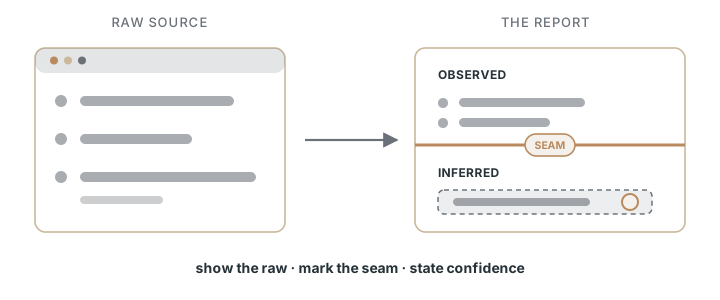
- Mark the seam between what you saw and what you guessed. The data I can trust; the inference on top I have to audit. Fuse them and you’ve hidden the one join that matters.
- Calibration, not confidence, is the scarce signal. Once you’ve been burned, unhedged confidence starts to read as the failure mode. Telling me how sure you are — loudest where you’re weakest — is what credibility looks like now.
Usefulness is the point
Start from the end. What does the reader do with this?
If the honest answer is nothing, stop. A true, well-argued, well-built report that moves no decision is waste with good production values. Spotting that something’s off was always the cheap half — often a threshold does it. The value is in knowing what to do about it.
So build backward. Not data-first — gather everything, analyse, bolt a recommendation on the end. Decision-first — start from the call the reader has to make and work back to exactly the evidence and confidence that call needs. The analysis is scaffolding for the action, not the product.
Usefulness also filters slop. “Monitor the situation.” “Improve quality.” You can’t act on those — and the moment you ask what do I actually do with this, the fluent nothing evaporates. A specific recommendation that’s wrong, you can catch and throw out. A vague one just costs you the reading and leaves the decision where it started.
Trust is verifiable, or it isn’t trust
You don’t earn trust by sounding certain. You earn it by putting the thing under the claim where the reader can reach it, and letting them check.
Same point as reading the code instead of its description: the summary can say one thing and the source another, and looking is the only way to know. So the output has to carry its source — the numbers under the chart, the records under the finding, one click from claim to raw. A confident sentence with nothing to open is a request for faith. A modest claim you can drill into is evidence.
And presentation is what gets the reader to drill in at all. That’s not decoration. A trace nobody opens is inert, and having the evidence in front of you isn’t the same as engaging with it. Make it navigable, or it goes unchecked — and unchecked trust is just being charmed.
The seam between seen and guessed
This is the join that matters most, and the one models paper over: what was observed versus what was inferred from it.
“The value dropped” is data. “So the process is failing” is a guess resting on the data. Both can be true. They are not equally trustworthy, and they don’t break the same way. Run them together in one smooth paragraph and the inference borrows the data’s credibility — smuggled in wearing its clothes. That’s confidently-wrong in miniature: not a false fact, but a true one fused to a shaky guess so you can’t see the join.
So split them. State what you measured. Then state what you concluded, and mark it as a conclusion. The reader trusts the first and audits the second — which is exactly what they should do, and can’t, when the seam is hidden.
Calibration is the new credibility
“Ignorance more frequently begets confidence than does knowledge.” — Charles Darwin, The Descent of Man (1871)
Here’s the inversion. Hedging used to read as weakness — if you’re not sure, why are you telling me? Now everyone has pattern-matched on the thing that sounded certain and blew up. I think unhedged confidence is becoming the tell. “Here’s how sure I am, and here’s where I’m shakiest” isn’t a hedge any more; it’s the signal that a real judgment happened, because the bluffing machine never volunteers its own soft spots.
The catch is the whole game: owning a weak spot only builds trust when the rest is strong. From demonstrated rigour, a flagged guess reads as honesty; hedge everything and it reads as noise. So the confidence has to be calibrated — high where earned, low where not, and the reader able to tell which is which. “Backed” and “this part’s a guess” have to live in the same piece, or neither one lands.
And calibrate at the right grain: mark confidence where the claims actually vary. A findings report mixes data and inference in every paragraph, so it needs the marks throughout. A signed opinion piece that told you up front it’s opinion has already set the dial — tagging every sentence would just be noise.
Don’t hedge — signpost
The trap is doing all of this in the prose. “It might be worth considering that perhaps…” — that isn’t calibration, it’s the mush register: it tires the reader and reads as machine-written, which burns the very trust you were building. Sounding unsure is not the same as being calibrated.
So keep it out of the sentences. Make the claim plainly, in your own voice, and put the confidence in its own channel — a level, a mark, a line that says how sure, set apart from the argument. Structured, not smeared through the prose. The writing stays confident; the calibration sits beside it, where the reader can find it and you can’t hide behind it.
The point
The model that learned from you tends to sound about as sure when it’s guessing as when it knows — the training signal rewarded fluency, not calibration. What you add is knowing which is which, and saying so. Useful enough to act on, open enough to check, honest enough to tell me where it would break. That isn’t a softer bar than confidence. It’s the harder one.
How sure I am: the confidence-and-trust research is prior art (cited); the decision-first and mark-the-seam framing is experience from building tools that people had to actually act on; the claim that calibration now beats confidence is a wager — argued, and I believe it, but I haven’t measured it. If this is wrong somewhere, it’s there.
Sources
- Sherman Kent, Words of Estimative Probability (1964) — the case for a fixed confidence vocabulary over vague hedging.
- Aronson, Willerman & Floyd (1966) — the pratfall effect: a competent source gains credibility by admitting a flaw.
- The Transparency Dilemma: How AI Disclosure Erodes Trust (2025).
- Barbara Minto, The Pyramid Principle; Stephen Toulmin, The Uses of Argument — structuring a claim with evidence, qualifier, and rebuttal.
- Observation vs inference / Results vs Discussion (IMRaD) — the discipline of separating what was measured from what was concluded.
Related: Familiarity Isn’t Trust (the other channel that inflates trust without adding evidence), Correct Is Not Usable (right in every sentence and still not actionable), The Raw Is the Trust Boundary (what verifiable costs to build), The Agent Will Invent the Bar (the fabricated citation arrives in the same confident voice as the real one).